Scale & repetition
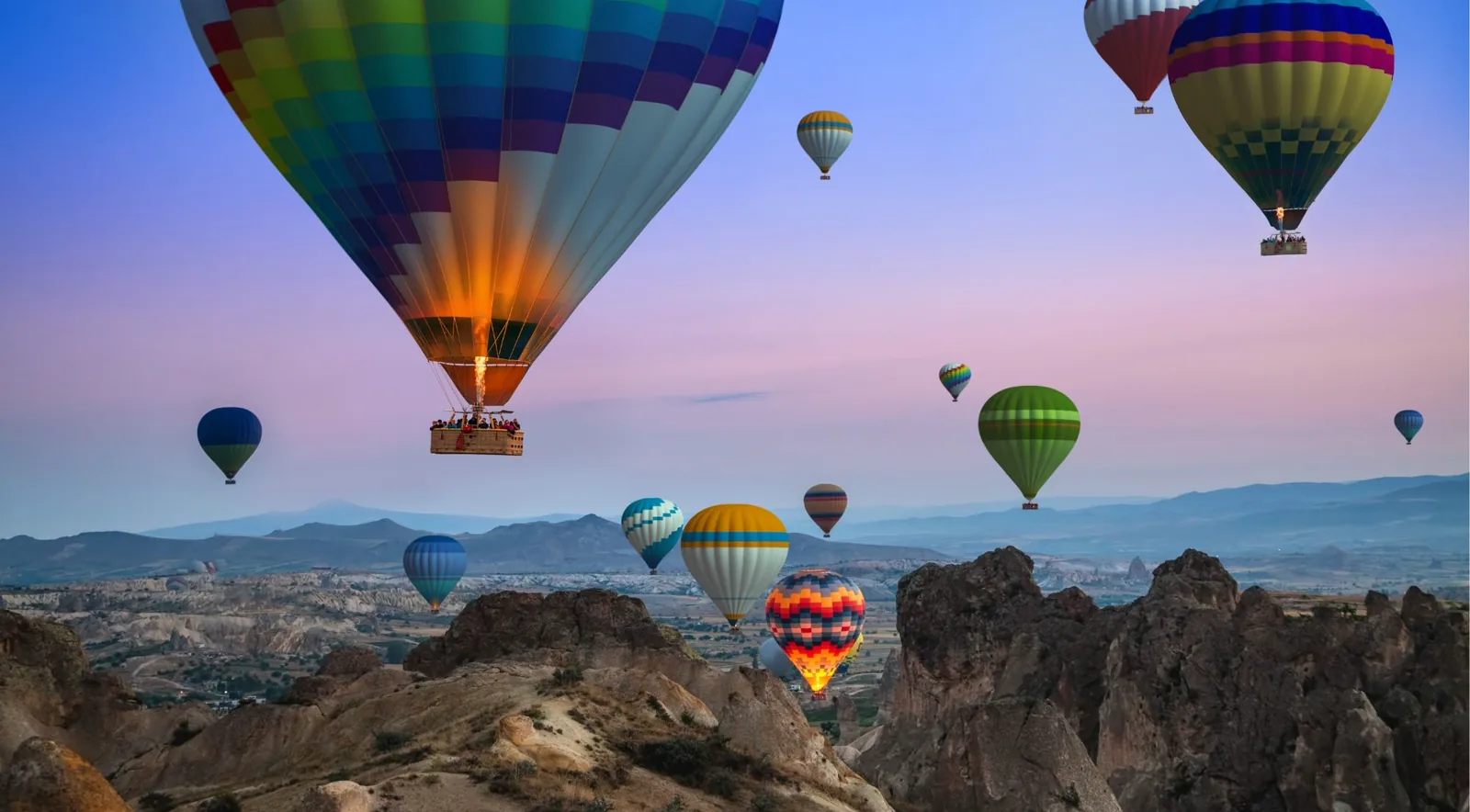
From dozens up to the 154-balloon daily cap set by SHGM's slot system, the balloons create natural visual rhythm and depth — foreground, mid-ground, and distant dots near the horizon. During BalonFest the total reaches 190–200.

Photo & Experience Guide · Updated 7 July 2026
Why the sunrise "sea of balloons" is the most photographed scene in ballooning, what the flight actually feels like, the best viewpoints on the ground, and how to capture it all.
Search "Cappadocia" and the image is already in your mind: dozens of glowing balloons drifting in a pastel dawn over a valley of stone cones. The reason these photos go viral isn't a single balloon — it's the density and the backdrop. As one traveller put it, what made her flight unforgettable "wasn't the fact that we were floating over the strange land formations — it was that there were 54 other balloons also in the airspace."
Cappadocia is the most photographed ballooning destination on the planet — the president of the Anatolian Hot Air Balloon Operators Association has said about 40% of all balloon flights worldwide take place here. Per SHGM data, 769,814 tourists flew over the region in 2024, up from 498,812 in 2015, with roughly 4.77 million over the past decade. Three things make the scene photograph so well:
Check live availability and prices for your dates:
From dozens up to the 154-balloon daily cap set by SHGM's slot system, the balloons create natural visual rhythm and depth — foreground, mid-ground, and distant dots near the horizon. During BalonFest the total reaches 190–200.
A 60-million-year-old volcanic canvas: fairy chimneys of soft tuff capped by harder basalt, cave dwellings and rippled valleys that glow cream, pink, rose and gold in low light — a backdrop that looks like another planet.
Low-angle sunrise light rakes across the tuff, lighting the balloon envelopes from the side and casting long shadows. The most magical photographic window is the first 20–30 minutes after sunrise.
A taste of what a Cappadocia sunrise looks like from the basket and from the valleys below.



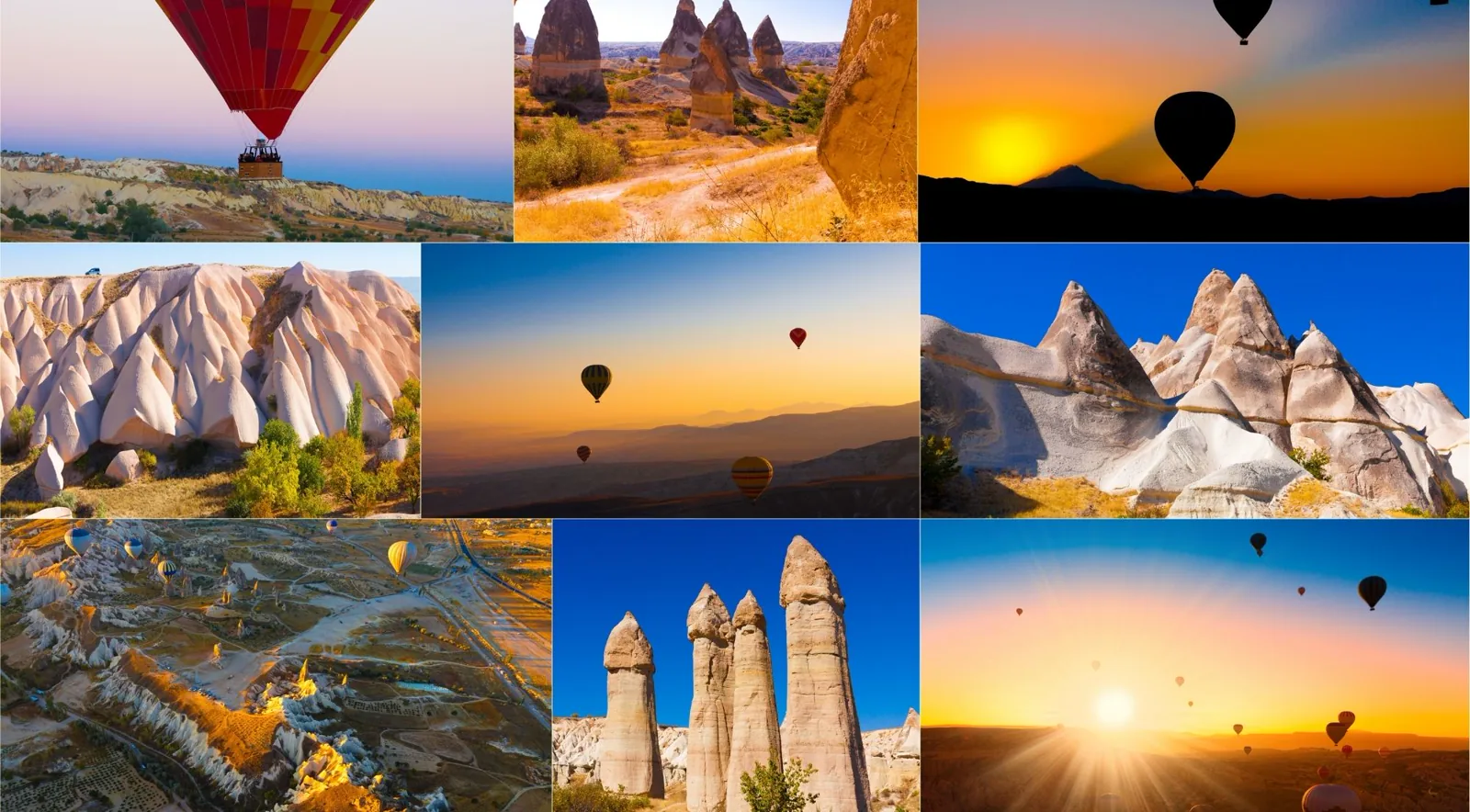


More ways to photograph Cappadocia — from the ground, on the ground, and beyond the balloon.
If you want guaranteed shots without heights, book a sunrise balloon-watching tour or a flying-dress photoshoot with a professional photographer. For golden-hour movement, travellers love dawn ATV and quad-bike tours through Love Valley and Rose Valley, and horseback rides past the fairy chimneys. Add the Göreme Open-Air Museum and its rock-cut frescoes, the Derinkuyu and Kaymaklı underground cities, an Ihlara Valley hike, or a guided Red, Green or Blue Tour. Many pair Cappadocia with Istanbul or a Pamukkale day trip. The live widget below pulls in the current top-rated Cappadocia tours, photo experiences and activities.
The four photos everyone comes for, and exactly how to get each one.
The signature image. Shoot at sunrise from a high vantage — either from your own basket once you've climbed a few hundred feet, or from a ridge viewpoint like the Göreme Panoramic Viewpoint, which offers a 360-degree panorama with 100+ balloons rising in front of you. Use a wide lens, include some foreground rock for depth, and work the 30–45 minutes around sunrise.
As balloons descend into the valleys, you float between and just above the cone-shaped pillars. Love Valley's 40-metre chimneys, the dovecote-pocked cliffs of Pigeon Valley, and the rose-red layers of Rose/Red Valley all read beautifully from above. A telephoto lens compresses layers of chimneys into a "dreamy layer-cake."
Frame a corner of the woven basket and a passenger's hands or silhouette in the foreground, with balloons and valley beyond — the basket edge anchors the viewer in the experience. Request a corner position when boarding for the cleanest forward and downward sightlines; a smaller or deluxe basket gives you more room to move.
Backlighting balloons against the rising sun creates dramatic silhouettes; on cloudy-break mornings, "god rays" stream between the balloons. From below looking up you get clean envelope-against-sky shots and burner-glow images — the easier option if you're nervous about heights or your flight is cancelled.
The experience is as emotional as it is visual. Here's the sensory arc, from pre-dawn pickup to the champagne on landing.
Because a balloon moves with the wind, there's no wind noise — just an eerie, weightless calm broken by the periodic roar of the burner. One traveller wrote that "the silence of rising up gave the feeling of being weightless and was just breathtaking and indescribable." On a basket full of strangers speaking different languages, "everyone fell silent once we were airborne."
No engine vibration, no rotor noise, no rushing wind. The ascent is vertical and slow — repeatedly described as "more gentle than an elevator." Unlike a cliff edge or a building, there's no hard structure connecting you to the ground, so vertigo sufferers often feel surprisingly calm. Balloons climb to around 300 m for the panorama and may descend into the valleys to skim the chimneys, then rise again.
The burner delivers a loud roar and a genuine blast of heat on your head and neck when fired — surprisingly warm even on a cold morning — then near-silence between bursts. The basket is bigger than first-timers expect, divided into compartments of 3–4 people; it's stable and solid, and you stand the whole flight, so wear comfortable closed shoes. Landings can be smooth or slightly bumpy; skilled pilots often set the basket directly onto the chase trailer, earning a round of applause.
The emotional climax, and a tradition dating to the 1783 Montgolfier flights, when pilots carried champagne as a peace offering to alarmed farmers. In Cappadocia you toast with Turkish sparkling wine (non-alcoholic options standard), receive a flight certificate and often a medal. People frequently cry, propose, or celebrate anniversaries here — a common refrain from first-timers is "don't let your fear deprive you of such a beautiful life experience."
Watching from below is "80% of the experience at 0% of the cost" — and the perfect backup if your flight is cancelled.
The undisputed champion — a 360-degree panorama on the Göreme–Uçhisar road with 100+ balloons rising in front of you. Free, but crowded. Arrive 30–45 minutes before sunrise.
You're below the balloons as they rise, with the famous 40-metre chimneys in the foreground and fewer crowds. One of the most dramatic angles anywhere in the region.
The highest point in Cappadocia (1,355 m); balloons appear below you like floating bubbles. Small entry fee, big reward on a clear morning.
Softer, romantic pinks that glow at dawn; some balloons land here, and it's often nearly empty at sunrise. Çavuşin hill and Ortahisar Fortress are quieter alternatives.
Sultan Cave Suites is the Instagram-famous terrace (very busy); Koza and Mithra cave hotels offer similar, less-crowded views. Most terraces are guests-only.
Balloons launch 30–45 minutes before the sun appears and drift with the wind — if it blows the wrong way, they may head away from your chosen spot. Have a backup viewpoint in mind.
Not flying — or grounded? A ground-based sunrise balloon-watching tour is the best-value way to get professional images: some include hotel pickup, photos and video, and even optional drone footage delivered the same day. Nervous flyers, families with small children, and anyone whose flight cancels all use them.
Guaranteed images without the heights — a private balloon photoshoot, a flying-dress sunrise session, and a low-cost balloon-watching tour. Live availability below.
Free cancellation up to 24 hours in advance
Free cancellation up to 24 hours in advance
Free cancellation up to 24 hours in advance
The golden light does half the work — these settings do the rest.
Shoot at sunrise/golden hour. A 24–70mm covers ~90% of shots; go wide for valleys, ~50mm for other balloons, and 70–200mm to compress chimney layers and distant balloons. Two bodies (one wide, one tele) is the pro move if you can manage it in a tight basket.
Enable RAW, lock focus, and expose for the sky — let the chimneys fall slightly dark. Use HDR and burst/Live mode to catch the moment the sun crests the valley. A GoPro or selfie stick helps for self-portraits since space is tight.
Set white balance to Cloudy or Shade to preserve the golden tones rather than letting Auto neutralise them. Use spot or centre-weighted metering so the bright sky doesn't fool the meter.
Fully charge batteries (cold drains them), bring spare storage, and secure your strap — a drop from the basket is gone forever. No drones: they're banned near launch zones and heavily fined.
Three sunrise flights chosen for photography — a small-group premium basket, prime-slot launches, and the iconic Göreme sea-of-balloons. All with live availability and free Göreme-zone hotel pickup.
Reserve now & pay later available
Reserve now & pay later available
Free cancellation up to 24 hours in advance
Why these three: a small-group basket built for photography (Royal King), an operator known for prime launch slots and in-flow upgrades (Atmosfer), and the most battle-tested Göreme operator for the iconic sea-of-balloons sky (Discovery). Compare all nine flights on the homepage lineup, or plan the timing with our best-time & FAQ guide.
Quick answers on timing, drones, the champagne, viewpoints and camera settings.
At sunrise only — there are no afternoon passenger flights, because that's when winds are calmest and the light is best. Two waves launch, the first just before sunrise and the second about 30 minutes later. The most magical photographic window is the first 20–30 minutes after sunrise.
No. Civilian drone flights near the launch areas are prohibited and enforced — as of 2025 the fine is 78,701 TL (~$2,200) per incident, and up to 131,176 TL for endangering manned aircraft. The density of balloons makes a collision a serious hazard, and Göreme National Park is a protected heritage zone. Pros shoot from the basket, use telephoto from ridge viewpoints, or hire licensed ground photographers.
It's a real celebratory toast, though usually Turkish sparkling wine rather than French Champagne (Royal Balloon pours Kavaklıdere "İnci Damlası"). Non-alcoholic juice or alcohol-free "champagne" is standard. The tradition dates to the 1783 Montgolfier flights, when pilots offered champagne to reassure alarmed farmers on landing.
The Göreme Panoramic Viewpoint on the Göreme–Uçhisar road — a 360-degree panorama with 100+ balloons, free but crowded. Great alternatives: Love Valley (you're below the balloons), Uçhisar Castle (the highest point), Rose/Red Valley, and cave-hotel rooftops. Arrive 30–45 minutes before sunrise; wind direction decides where the balloons drift.
On a good morning, well over a hundred — SHGM caps the daily total at 154 balloons. During the BalonFest festival the total reaches 190–200 with the special-shape fleet. That density is what makes the "sea of balloons" photo so iconic.
Shoot at golden hour, enable RAW, and expose for the sky so it doesn't blow out. Set white balance to Cloudy/Shade to keep the golden tones, use spot or centre-weighted metering, and a 24–70mm lens for ~90% of shots (add 70–200mm to compress chimney layers). Charge batteries fully, bring spare storage, and secure your camera on a strap.
The photos that go viral are all shot in the 30 minutes around sunrise, from the basket or a ridge viewpoint. Book a flight (or a ground balloon-watching tour) for the first morning of your stay, with free cancellation, so weather can't cost you the moment.